Insights From Our Experts
How brand clarity keeps decisions, behavior, and belief steady when everything else is shifting.

The Spreadsheet Reflex
Many senior leaders underestimate the role brand plays in business strategy. For some, brand feels cosmetic. For others, it feels secondary to execution. When organizations are under pressure, brand is often put to the side and treated as something that can wait.
That instinct makes sense. Change creates urgency, and leaders feel accountable for progress that can be measured and defended. Spreadsheets feel tangible when uncertainty is high. Brand can feel abstract, and its impact harder to measure.
But what becomes clear during periods of change is that tactical efforts are rarely the issue. Change becomes problematic when people are asked to move forward without a shared sense of what the organization stands for and how they belong within it.
Brand as the Counterweight to Uncertainty
Done right, a strong brand provides employees, customers, and partners with stabilizing forces that absorb the impact of organizational change. These counterbalancing effects are far more tangible than many leaders realize.
Amazon founder Jeff Bezos famously said, “Your brand is what people say about you when you’re not in the room.” For spreadsheet-minded leaders, that definition can seem symbolic, nebulous, and impossible to break down into hard-hitting data points. In practice, however, brand does show up in measurable ways.
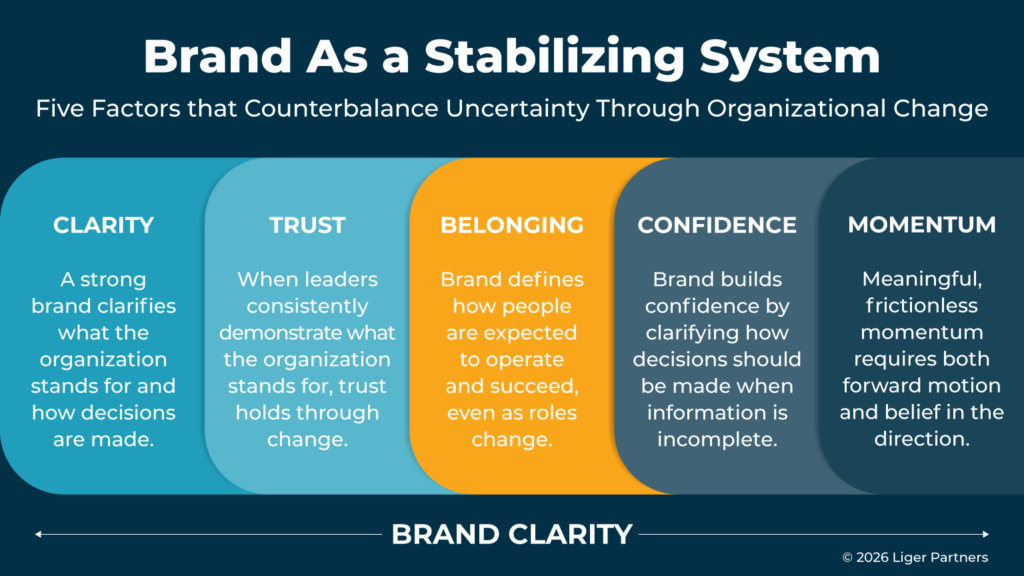
Here are five stabilizing forces a strong brand delivers during disruption:
1. Clarity
During change, leaders make decisions faster and with less information, requiring teams to do the same. When clarity is missing, decisions slow down or swirl unnecessarily.
Brand creates clarity by defining what the organization stands for and using that definition as a reference point.
During Airbnb’s period of rapid growth and regulatory pressure, leaders faced constant tradeoffs. Rather than evaluating every situation from scratch, decisions were anchored to a clear idea of belonging. That definition helped teams determine which options fit and which did not, even as policies and markets shifted. The strong brand and vision of the company reduced ambiguity.
Takeaway: Brand clarity provides teams with a shared point of orientation when certainty is not available.
2. Trust
Trust is fragile during change. It erodes quickly when teams hear one message and experience another.
Brand stabilizes trust when leaders clearly define what the organization stands for and consistently reference that definition in how decisions are made and communicated.
Microsoft’s transformation succeeded because the company treated brand as a behavioral standard. The growth mindset showed up in how leaders talked about performance, how collaboration was encouraged, and how learning was rewarded. Employees could predict leadership behavior because it followed a defined pattern.
Takeaway: When leaders clearly define what the organization stands for and use it consistently across decisions and communication, trust holds through change.
3. Belonging
Change often disrupts people’s sense of place before it disrupts their workload.
When roles shift or structures evolve, employees start asking quiet questions. How am I expected to operate now? What matters? How do I succeed here?
Brand answers those questions by clarifying how people belong.
As Slack scaled rapidly, formal systems lagged behind hiring. What kept teams aligned was a clear brand voice and set of values that shaped communication and collaboration. New employees understood expectations before processes were fully documented.
Takeaway: Belonging is not a morale initiative. It’s confidence in how people are expected to contribute.
4. Confidence
Uncertainty creates hesitation. When people are unsure what matters most, they wait. Decisions stall, and risk avoidance increases.
Brand restores confidence by making priorities explicit.
Apple’s reinvention was driven by focus. Leadership eliminated noise and aligned around a small set of core ideas. Teams didn’t need constant validation because the brand made it clear what deserved attention and what didn’t.
Takeaway: Confidence doesn’t come from having all the answers. It comes from knowing how to decide when answers are incomplete.
5. Momentum
Leaders often describe change as losing momentum. What they’re really describing is loss of belief.
Brand sustains momentum by helping people understand where their effort is headed.
IBM’s shift from hardware to services required employees to rethink how their work created value. Brand helped leaders connect daily execution to a credible future. That connection reduced resistance and kept energy focused on progress rather than loss.
Takeaway: Momentum requires both forward motion and belief in the direction.
The Leadership Shift That Makes Brand Work
When change feels slow or exhausting, the instinctive question is often, “Why is this taking so long?” A more useful question reveals the real issue.
Where does my team lack clarity right now?
That question reframes the brand from a creative exercise into a leadership tool. It directs attention to definition, alignment, and consistent reference rather than pressure and urgency.
Brand clarity gives people a stable reference point for decisions, behavior, and communication while everything else is changing. That stability reduces friction, restores trust, and allows work to move forward without constant intervention.
The CFO Takeaway
The financial impact is measurable. Gallup’s research shows that clarity of expectations and engagement are closely tied to performance outcomes such as productivity, turnover, profitability, and customer loyalty, with highly engaged teams showing up to 14 % higher productivity, up to 23 % higher profitability, and substantially lower turnover and absenteeism compared with less engaged teams.
Brand, when clearly defined and consistently referenced, directly addresses these risks. It reduces friction in decision-making, stabilizes trust, and sustains momentum while priorities shift. In financial terms, it protects execution efficiency when organizations are most exposed.
For leaders accountable to boards and investors, brand is more than just a creative expense. It’s a system of risk-mitigation and performance-stabilization.
Bottom Line: In periods of organizational change, systems that preserve brand clarity preserve value.Let’s define the brand anchors your team can use to make faster decisions through change. Book a Discovery Call to get started.