Insights From Our Experts
Earning trust before the click in AI-driven search

I have a love-hate relationship with marketing buzzwords. They roll by every few months, and then everyone swarms around them like gnats to a lightbulb. The hot ones right now are AEO, GEO, and the growing list of terms that mostly mean “SEO, but for AI” and sound like Old MacDonald’s Farm.
But sometimes a new term comes along that gives language to an idea that deserves more attention. This is especially valuable when we sense a shift but haven’t quite figured out how to talk about it.
That’s how pre-alignment hits for me. I kept seeing the same pattern emerge without a clean way to describe it. And BAM. There it was, a name for it. Pre-alignment. So lovely.
So, you ask, what the heck is pre-alignment?
Pre-alignment is the moment a buyer encounters a fragment of your thinking in an answer-seeking context, often via AI search, and determines whether you understand their problem well enough to engage.
TL;DR: Trust forms before engagement.
Pre-alignment is kind of like checking out someone’s profile on Hinge before you chat. You’re taking in the information in front of you, which surfaced because it matched your behavior and intent, and you’re assessing whether to move forward.
In a much less prescriptive way, marketing works like that now. In AI-search environments, trust happens farther upstream than before. Buyers may encounter pieces of your messaging that start to shape solutions to their problem long before they engage with you. When it works, there’s a spark. A sense of recognition that says, this reflects what I’m dealing with in a meaningful way.
That spark matters more than many SEO-oriented content teams realize. It’s less about volume and visibility and more about whether what surfaces reflects the buyer’s intent closely enough to earn their attention. And even before that, the AI algorithms have to trust you enough to serve your information up to the buyer.
Alignment used to be shaped in the pitch meeting, or in the lower funnel. Now, before there’s interest in your brand or your capabilities deck, there is ideological pre-alignment, or there isn’t.
The term may be new, but the idea really isn’t.
Pre-alignment gives new language to something thoughtful marketers and business leaders have been circling for decades. It’s essentially content marketing as it was always intended, now powered by AI at lightning speed.
Peter Drucker, widely regarded as the father of modern management, spent much of his career reminding leaders that clarity about the problem comes before action. His work emphasized understanding the customer’s context and purpose of the work before measuring performance or optimizing systems. He didn’t call it pre-alignment, but the idea that alignment must come before execution runs through everything he taught.
Clayton Christensen advanced this thinking through his Jobs to Be Done framework, which reframed how companies think about why people buy. His insight was simple but profound: people don’t buy products in the abstract. They “hire” solutions while navigating specific situations, pressures, and constraints. If marketing reflects those circumstances, it feels relevant. If it skips them, it feels disconnected.
Seth Godin has long argued that effective marketing is rooted in empathy, trust, and relevance. His work consistently points to the idea that people engage when they feel understood, not targeted. In his 1999 book Permission Marketing, Godin argued that:
- Marketing should be an invitation, not an interruption
- Trust and relevance come before persuasion
- Attention is earned over time, not bought once
He wrote this 25 years ago, and he didn’t use the term pre-alignment; but empathy before influence has always stood at the center of his philosophy.
Across decades and disciplines, the empathy throughline holds. What’s changed is the environment. It’s easier than ever to skip this step and jump straight to execution as AI accelerates content creation. At the same time, buyers are using AI to search, which makes skipping it riskier than ever. In modern marketing, pre-alignment makes up most of the buyer’s journey, and the opportunity appears and disappears almost instantly.
AI has made marketing faster, not clearer
The new toolset has made content faster. It hasn’t made it easier to be understood. Clarity is now the work of marketers.
Rushed AI content appears mostly correct and well produced, yet mechanical and hollow. The tone is polished and confident, but the content itself feels interchangeable. Reading articles, especially on LinkedIn lately, feels like kissing toads to find a prince.
The people making buying decisions on the other end of your GEO and AEO tactics feel this. In a moment when clarity can be delivered at lightning speed, much of the content being produced can’t be trusted.
Google’s recent updates have made this dynamic more visible. Content grounded in original thinking and human experience is being rewarded, while material that feels formulaic or produced at scale without insight loses ground.
In the complex B2B environments our clients tend to work in, more clarity really helps. They need information that reflects the pressure they are under. So, for us, that’s where pre-alignment matters.
How I think about pre-alignment in practice
I’ve used the same mountain metaphor for years to explain what effective marketing communications look like. I think people politely get tired of me talking about the mountain. But, heads up! Here we go.
I draw a mountain. I draw myself standing on the left side of a mountain. From there, I have a certain perspective. I can see patterns, tradeoffs, and possible paths forward that aren’t always visible from the side of the mountain I came from and where my client, usually a corporate marketing leader, is standing. I’ve been there, and they’re in it. Navigating internal pressure, high expectations, limited time, competing priorities, budget restrictions, and emerging technologies. They don’t have the same point-of-view I do, not because they aren’t just as capable, but because they’re standing in a different place.
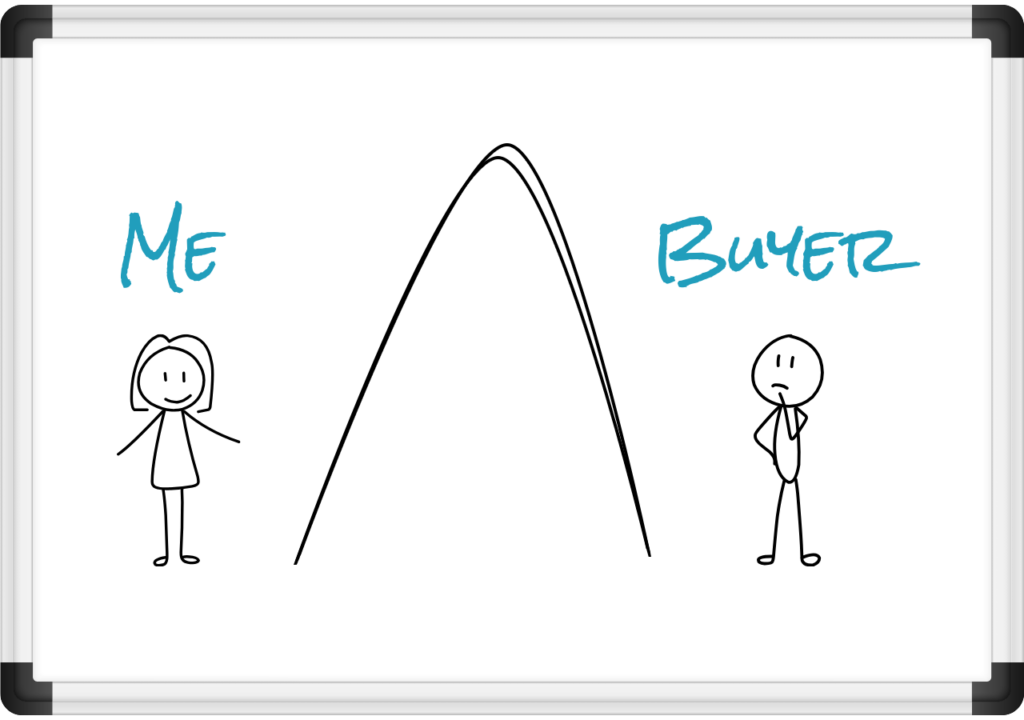
Side note: One of the advantages of agency work is that I get to learn across businesses. That exposes me to patterns and insights that are harder to see when focused on a single company.
If I stay on my side of the mountain and talk to them from there, not only am I yelling, but what I say isn’t relevant to them yet. Even good advice sounds like noise when it’s coming from a place they haven’t reached.
Pre-alignment is what happens when I, instead of yelling across the mountain, climb back over to meet them where they are. Let me say that again: I meet them where they are first, before I advise them.
When I meet them eye-to-eye (but, you know, with digital content), I acknowledge the constraints they’re under in plain language. That’s when real connection becomes possible. Sharing an understanding of the problem allows trust to form. And hopefully, I earn the chance to be their guide, and we can cross the mountain together.
In practical terms, this is what pre-alignment looks like in content marketing. We’re communicating with our buyers in their context, aligning around their pain points, first taking the time to research what those are. We name their challenges before offering a point of view and earn the right to walk alongside them toward better outcomes.
Pre-alignment drives momentum
I see pre-alignment as a spark that forms through progression on both sides, when intentional marketing action meets buyer intent at the right moment. It may be the missing link marketing has always needed.
Pre-Alignment Alchemy
How insight becomes trust before engagement
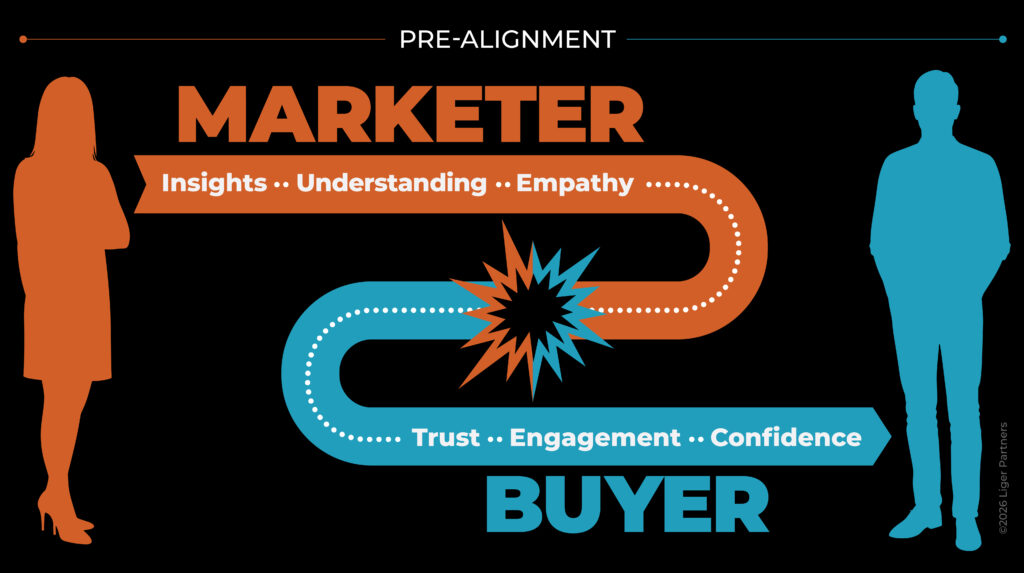
Insight leads to empathy. Empathy creates the conditions for pre-alignment. Pre-alignment makes engagement feel natural instead of forced, like a dating app learning and serving up decent matches for you (this is where AI is improving the research experience). If it builds trust, it leads to engagement, which can develop into confidence. Buyer confidence, in turn, is really the only way to build momentum for your business.
What’s the difference between trust and confidence? Trust is the moment someone believes your credibility. Confidence is the moment they believe they should choose you.
When teams skip steps in this new buyer path, they end up trying to manufacture engagement or push for action before the buyer is ready. When you honor the exchange and let the sequence unfold, real momentum can follow.
Why This Matters Now
I don’t think pre-alignment is revolutionary. I think it’s a name for something that has always mattered and is harder to ignore now that the noise in content production has increased, and AI has, at the same time, made buyer research more precise.
AI will continue to accelerate production and support us in many ways. What will matter in marketing is the ability to connect through trusted messaging that resonates.
If pre-alignment is a word that reminds you to make one clearer decision this quarter, it has earned its place. The question is, do you love it, or do you hate it?